The Collatz Conjecture
June 21, 2026, 4:25 PM (GMT+6)
For the last few months, I’ve been thinking about an unsolved problem called the Collatz Conjecture (3n + 1 problem)—a rule so simple it feels almost innocent, yet it hides behaviour no one has ever truly understood. It simply starts with an integer, but instead of producing a polite pattern, the sequence seems to wander like it has a mind of its own.
Statement of the Problem
Take any positive whole number and apply this rule:
- If the number is even, divide it by 2.
- If it is odd, multiply it by 3 and then add 1.
Using modular arithmetic notation, we define the function $f$ as follows:
$$ f(n) = \begin{cases} n/2 & \text{if } n \equiv 0 \pmod 2, \\ 3n + 1 & \text{if } n \equiv 1 \pmod 2. \end{cases} $$
Now create a sequence by repeatedly applying this rule, starting from any positive integer. Each result becomes the next input in the process. In notation:
$$ a_i = \begin{cases} n & \text{for } i = 0, \\ f(a_{i-1}) & \text{for } i > 0 \end{cases} $$
$a_i$ is what you get after applying the function $f$ to $n$ a total of $i$ times in a row. So we can also write it as $a_i=f^i(n)$.
The Collatz conjecture states that no matter which positive integer you start with, this process will always eventually reach $4 \to 2 \to 1$. In other words, for every starting value $n$, there exists some step $i$ such that $a_i=1$.
If the conjecture turns out to be false, then somewhere there must be a starting number whose path never reaches 1. It would mean the sequence either gets stuck in a loop that avoids 1 forever, or it somehow grows without bound instead of settling down.
What’s strange is that, despite all the testing and effort, no one has ever actually found such a sequence. It’s been verified that the conjecture works for all positive integers up to $2.36 \times 10^{21}$, yet despite this massive range of checked cases, no general proof has ever been discovered.
Empirical Data
For example, starting with n = 12 and applying the function $f$ step by step (without any shortcuts), we get: 12, 6, 3, 10, 5, 16, 8, 4, 2, 1.
Starting with n = 19, it takes a longer path to reach 1: 19, 58, 29, 88, 44, 22, 11, 34, 17, 52, 26, 13, 40, 20, 10, 5, 16, 8, 4, 2, 1.
And for n = 27, the behavior becomes even more striking. The sequence stretches out to 111 steps (with 41 of those coming from odd numbers), rising all the way up to 9232 before finally falling back down to 1. 27, 82, 41, 124, 62, 31, 94, 47, 142, 71, 214, 107, 322, 161, 484, 242, 121, 364, 182, 91, 274, 137, 412, 206, 103, 310, 155, 466, 233, 700, 350, 175, 526, 263, 790, 395, 1186, 593, 1780, 890, 445, 1336, 668, 334, 167, 502, 251, 754, 377, 1132, 566, 283, 850, 425, 1276, 638, 319, 958, 479, 1438, 719, 2158, 1079, 3238, 1619, 4858, 2429, 7288, 3644, 1822, 911, 2734, 1367, 4102, 2051, 6154, 3077, 9232, 4616, 2308, 1154, 577, 1732, 866, 433, 1300, 650, 325, 976, 488, 244, 122, 61, 184, 92, 46, 23, 70, 35, 106, 53, 160, 80, 40, 20, 10, 5, 16, 8, 4, 2, 1.
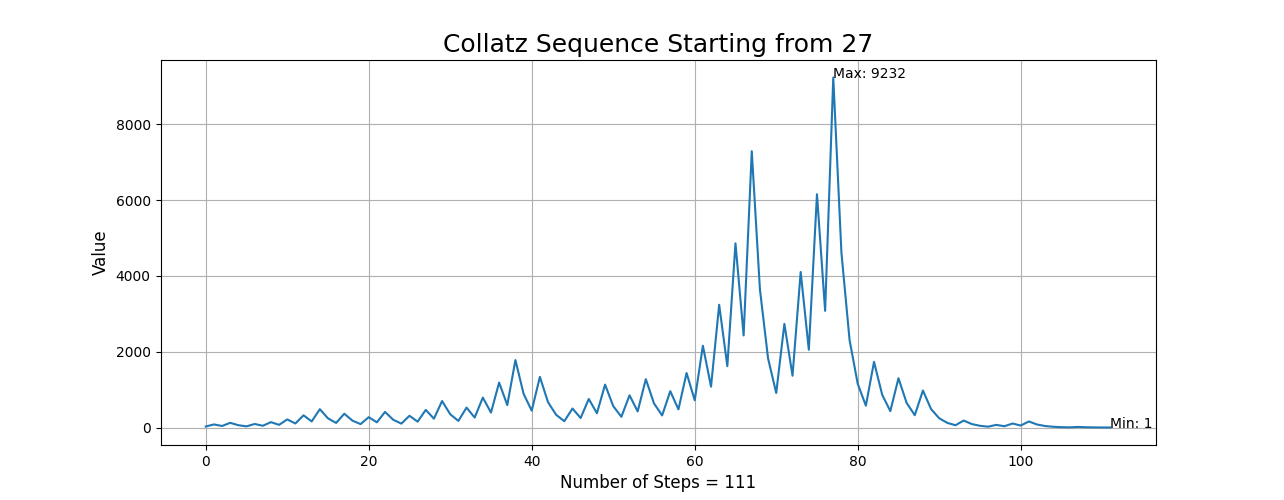
It’s strange how something so simple can behave in such an unpredictable way. The more I look at it, the more it feels less like a problem with numbers and more like a problem with understanding.
Maybe the real mystery isn’t whether every number reaches 1, but why such a simple rule can create such complicated paths.
I don’t have an answer to this yet (no one does), but every sequence feels like another small clue. I guess I’ll keep following where the numbers go.